For more info see Pete Thomas’ Mr. Lucky CD.
For more info see Pete Thomas’ Mr. Lucky CD.
Suzy, Jim, John, and I had our second gig so far. Remember we are all late bloomers, with two to four years experience on our instruments so far. Suzy started playing last year, John the year before that, and Jim the year before that. All three had played clarinet in some capacity in Jr. High or High School. I started four years ago on the same instrument I played through high school. We are a shy bunch, well some of us anyway. Some of the group thinks we should only play when we get around to sounding good. :o)
I believe that you learn as you go, woodshed like crazy, and then do the best you can for the gig. Of course, I am usually out voted by the rest of the group. So when Tammy offered us this chance to play in front of not-too-descriminating kids, I jumped at the chance to do just that. We played a number of songs, usually soprano, alto, tenor, and bari sax. But one that was requested was ‘Prayer’ by Humperdinck which is written for alto, alto, tenor, and bari sax.
Then we talked with the crowd of youngsters about our experience, instruments, and favorite music memory. The kids ranged from three to five years of age and were very active throughout the performance. There were some teenagers and adults there to perform crowd control and of course Tammy, who created the syllabus and taught the class. Because it was snowing so heavily, we combined three classes into one and then high tailed it for home, shortly thereafter.
By the way a little snow in Seattle can really be devastating. There are a lot of people who can not drive in snowy weather. Suzy and I, being from the mid-west have no troubles with what little snow we have in Seattle. But we really have to be careful of the drivers who should not be driving because they don’t understand the dynamics of ice and snow.
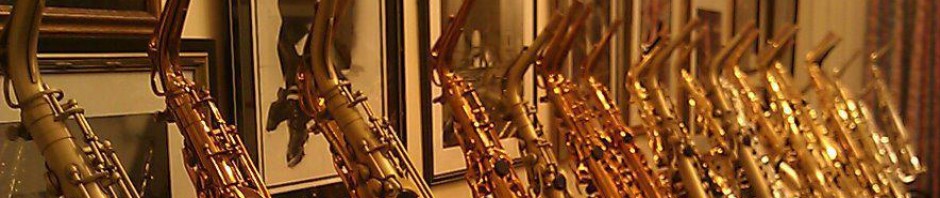
My friend Matt always seems to have very interesting musical instruments. Today I looked a very heavy gold alto sax made by Conn. It had the famous Naked Lady logo but this was the first time I had seen the logo with the full body torso. This instrument is due for a full refurbishing with new pads, adjustments, and a light polishing so as not to ruin the finish or engravings. I expect this instrument will go for over $5000 to a collector in Japan or Europe.
I also looked at a Kohler & Chase bass sax that is not to be confused with instruments made by Kohlert. Matt suspects that this instrument was originally made in France but there are no distinctive markings or engraving clues.
This instrument is in very nice condition having just had an overhaul and polishing done on it. As is true with all the bass saxes I’ve tried getting the D2 to speak was difficult but using the palm key D got the note play just find thank you. I would need a lot of time on this instrument to get it to play as strongly as I would want it to.
Using a neck strap is definitely not the way to go for a bass sax neophyte like me. With in minutes I could feel the weight start to feel uncomfortable. This is where a nice sax stand would come in nice. And I’m really anxious to get the Runyon Custom bass sax mouthpiec that has been reworked by Paul Coats. It will be interesting to see it this reworked mouthpiece will improve the intonation, dynamics, and sound of the bass sax.
Thelonius, we call him Theo, is now four months and quite the ball of energy. He loves to chew on our feet, try to craw up our legs, eat and play. You can run him for a long time before he gets tired. He sleeps with our other cat Max in the bed at night and is able to sleep the whole night without waking us now. This is a picture of the sated Theo after a nice big turkey dinner. Happy Holidays everyone.
After a number of years listening to , studying, and researching the bass sax, I have finally bitten the bullet and purchased a Buescher bass sax vintage 1921. ONe of the best sites that discusses the challenges of owning a bass sax is Helen’s Bassic Sax site. And part of the draw of this particular instrument was that I was buying it from Wade Walker, Jr. who I knew from a number of sax forums including the one he adminstrates, the C Melody Sax forum.
Wade listed this bass sax on eBay and there was a lot of action on the auction. So a couple of hours before the end of the auction I conferred with Suzy and then hit the ‘Buy it Now’ button. I had been considering a $20,000+ Eppelsheim bass sax, but after hearing Paul Woltz play his Buescher, I decided that this was the way to go. Now if I can only get some quality time with Paul, life will be sweet.
I called Wade as he had his impressive resume, he’s a geek like me, on the Web. Wade is the director of a city band and has sax repair skills. The mouthpiece is a Runyon that has been refaced by our friend Paul Coats. I’ve also purchased a number sax quartet/quintet arrangements by Paul.
The Eppelsheim bass is a custom instrument of world-class pedigree. It is stunning in its conception and the modern equivilent to the Mercedes, a luxery ride in the sax world. But that’s a lot of money for anyone, especially a late bloomer, such as myself.
I hoping to play the bass sax with some of the bands I play with and in my fledgling sax xTet. Right now we have four very rookie players, all who are returning to music after many years away from music. I’ve been purchasing music for a number of years and we have a nice set list so far.
Ray Guyll on reeds and Kim Dare on keyboards played their first night with the Second Story Rep pit orchestra for ‘Anything Goes’. I can’t imagine the stress associated with being a sub and coming in to an ensemble with only one practice under your belt. Kim has the most to do because she plays the piano while she directs the ensemble.
Ray has a number of solos, or exposed parts to play in the parlance of the team. He has played with so many ensembles and bands, but I suspect this is the first he has played with that we have to play so quietly. Playing quietly is a real challenge for a reed as getting the reed to speak is even more challenging because the sound is based on a vibrating reed. Consider that plus moving from instrument to instrument, where you pick up the instrument and basically play it cold at a moments notice.
Suzy and I are having a blast. She said that last night’s performance was her best to date. Her timing is impeccable as with the new people, she, Liz the flutist and I had to cover any lapses. The music is made even more challenging because we are backing up singers who are relatively inconsistent and with a new conductor, well let’s just say, no one was thinking this was the best night ever.
But my daughter and her husband were in the audience and they said the music was fabulous. Josie could hear both her parents where most people would just hear the ensemble as a whole. Of course, Josie played clarinet so that makes it easier to catch our parts. I want to repeat that other than the soprano sax solo, which is way too short ;o) I am luvin’ playing the baritone sax. And I really get to let it bark during the dancing scenes where we are not trying to play under the singers. The music is rather jazzy and that is what I prefer anyway.
As a jazz saxophonist, of little repute, I enjoy finding a riff in a solo and running with it. To me it provides context and can make the solo ride just that much more fun. In jazz, solo’s are rarely scripted or written out, so every time I play a solo, it’s like finding a new path. But if I have a feel for the riff, then there is much joy in jazz land, at least for me. And using the riff I can create consistently interesting solos.
Wikipedia defines riff thusly: In music, a riff is an ostinato figure: a repeated chord progression, pattern or melodic figure, often played by the rhythm section instruments, that forms the basis or accompaniment of a rock music or jazz composition. They can be as simple as repeated saxophone honking an entire chorus on a single exciting note by Big Jay McNeely or as complex as the head arrangements played by the Count Basie Orchestra.
David Brackett (1999) defines them as, "short melodic phrases," while Richard Middleton (1999) defines them as, "short rhythmic, melodic, or harmonic figures repeated to form a structural framework." Though Rikky Rooksby (2002, p.6-7) admits that there is no "water-tight" definition, he gives a "working description" for riffs in rock: "A riff is a short, repeated, memorable musical phrase, often pitched low on the guitar, which focuses much of the energy and excitement of a rock song."
Riffs are often used (and re-used) to create full compositions. The "Night Train" riff was first used in Duke Ellington’s "Happy-Go-Lucky Local", which Ellington had recycled from Johnny Hodges earlier "That’s the Blues, Old Man". The riff from Charlie Parker’s bebop number "Now’s the Time" (1945) re-emerged four years later as the R&B dance hit, "The Hucklebuck", while Glenn Miller’s "In the Mood" had an earlier life as Wingy Manone’s "Tar Paper Stomp". (All these songs use twelve bar blues riffs. It is probable that these riffs precede the examples given.)

Quinn the Eskimo Vintage Horns


 The Bis Key Chronicles