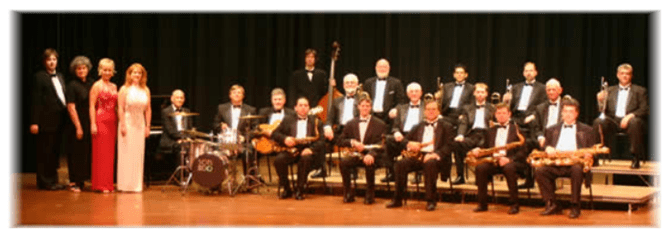
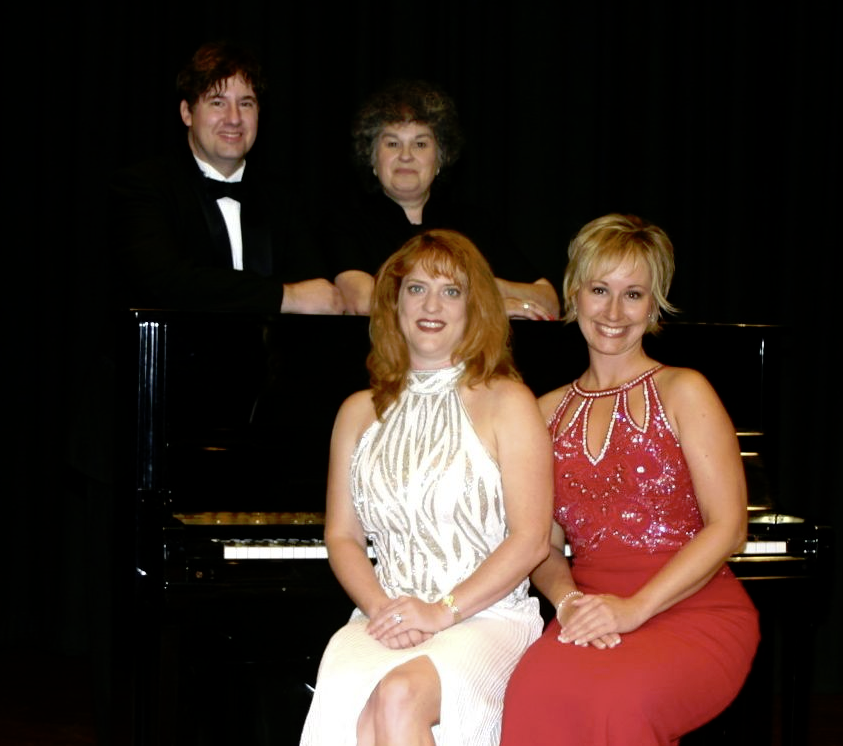
After posting yesterday’s missive providing my rather rudimentary observations about managing a Big Band, my friend Terry Stibal, a professional musician and band manager for most of his life provided this much more thorough guidance. Here’s a picture of his band the Sounds of the South Dance Orchestra.
SOME DIFFERENT PERSPECTIVES
I’d like to add a few things here, based upon the last nine years of fronting a band. (I’ve also played in a number of other such groups, both pro and amateur.) Some are complementary to your post, some are contradictory, and some are in addition to what you’ve already posted. And, almost all of them have very little to do with the actual playing of the music.
A BASELINE ASSUMPTION
There are three levels to what we do:
 The first is PLAYING MUSIC. Any band member or vocalist can do this, or they wouldn’t be there in the first place.
- The second is PERFORMING MUSIC. Most of us can do this as well. It’s a bit more than blowing the notes on the page (more on this below under music stands) – it involves putting feeling into the chart, not just going through the motions. It involves proper phrasing and locking the section work together, blending with the group’s “sound picture” and stuff like that there (with apologies to Bette Midler).
- The critical third level is ENTERTAINING WITH MUSIC. Only a select few can do this, and it usually involves a gifted performer. These folks are the ones you want to have in your principal chairs, and out as a vocalist. They have got their timing down to a science, they know how to recover from the occasional disasters that occur in live performance, and they can “connect” with an audience while they’re doing it. Over the years, I have known perhaps ten people who can attain this level naturally, and a larger number who are willing to work towards it.
If you want to see this level in action, watch your group perform, and then watch Bette Midler, or (shudder) Cher, or even Brittany Spears. While their music may be crap (certainly in the last instance), their company puts on a show, a show that is targeted to their audience and one that works very well. They stage a flashy show, not just some knockout music.
SOME STAGING ADVICE
Showmanship involves extra effort. For an example, take “Hit The Road, Jack!”, the Ray Charles classic. My group could just play and sing this, but we go a bit further to make it more engaging.
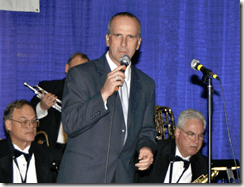 I start by programming a block of R & B stuff for my male singer, usually to start out our R & B based dance set. It’s high energy stuff, and familiar tunes to get the butts out on the dance floor.
Then, after his last solo tune, as he is taking his applause, we start in on the vamp (usually eight bars at the top of the tune) to “Hit The Road, Jack!”, during which the three girls march out on the stand, in time with the music and flirting with the crowd as they enter. Once out on the stand and as the end of the vamp comes up, the lead girl cues the intro and they start in on the first chorus.
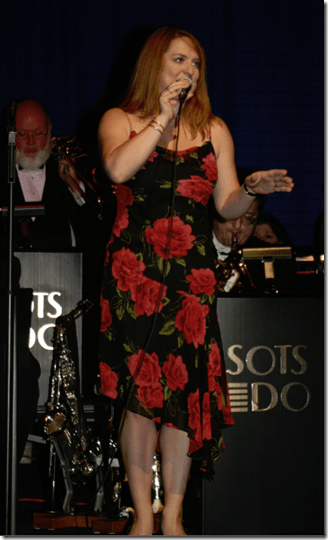 They play off against the male vocalist through the tune, with particular attention to the sassy “Don’t care if you do” section in the middle of the tune. This is followed by a rough sax solo of sixteen bars, during which the girls pantomime with the boy singer in the form of a fake argument. Finally at the end, they “chase” the boy singer off the stage. The final hit on “Road” comes (at which they “vogue” a classic three way pose), they take the applause, they come out of the pose, and we immediately shift into a girl R & B tune, usually “R-E-S-P-E-C-T”. A smooth transition between both the two tunes, and between two different vocalist lineups, all with a nice touch of cute in the bargain.
In our case, we play recognizable, four to the bar tunes that are fit to the target purpose – dance music for folks who no longer know how to dance the boogie woogie. In a nine hundred chart book, perhaps 30% is “old” music, 30% are standards from the 50’s up, and the balance are stuff from after 1965. But, a similar approach can be taken with a little trouble. It’s easy to go thematic with such a wide swath of the “American song book”.
It’s hard to do this with a “jazzer” book. It would help a lot to buy some viable charts that the audience can recognize. You can do this too, and it’s not as expensive as you might think.
I can get any tune arranged from a lead sheet for about $40.00. Put up a collection for new charts (each part runs about $6.00), order them from Dick Spencer (either “off the rack” or custom) or arrange them yourself, and fill out your collection that way.
SOME FUN, BUT NOT TOO MUCH
Fun with the band can work for you or against you. Act too goofy, or like “Aren’t we cool?” and you risk losing the respect of some listeners. Keep well in mind that you are there to entertain them, not to amuse yourselves. (Jim points this out as well, just not in as many words.)
A lot of this depends on the “front people” that are the face of the band to the audience – some can vamp and joke, and others are too wooden to manage anything more than their songs. You’ve got to be flexible, as do they.
 Another thing that I’ve had trouble with is the use of hats. Most trumpet and trombone players don’t want to bother with them, but their proper use add some “flash” to the group. Check out Miller’s group in Orchestra Wives and you’ll see an excellent example.
Flipping those things around may take a little extra effort, but it’s something that the audience, not well versed in things musical, can easily understand. Yeah, it’s corny, but corn sells as long as you do it with a little class.
Also, in the same film, Miller’s boys do the seminal performance of “At Last”. (It was written for the movie.) During a trombone chorus at the start of the tune, the four bones stand in a circle and play their tutti section. Very visually arresting, and something that I’d like to have my guys do, if only we had a similar arrangement.
All in all, it’s a movie worth watching. Plus, you get to see Dale Evans back when she was a band bimbo, and Henry Morgan – both are in the movie but uncredited.
VOCALIST AND BAND MEMBER INTROS
 Over the years, I have given up on “personalizing” the band, instead only “introducing” vocalist and extended soloists. I know that this doesn’t seem fair, but the audience is there to hear music, not a bunch of extraneous detail that doesn’t add to the musical experience.
I have an extended “meet the band” number, written by the late Walt Stuart, that we have never used. For one thing, it’s a “jazzer”, music that isn’t recognizable to the average listener. Also, it’s not danceable, or even listenable to anyone who’s not heavily into the jazz idiom.
 I do make the occasional introduction. (I have a switched mike at my station.) The first time a vocalist comes up, they are always introduced, either by me or by another vocalist. The vocalists get a short intro when they first perform, and a “farewell” when they do their final tune in the last set. In between, there may be an incidental reference (an example: “Now, I’m going to bring Katrina up here so we can do that Nat King Cole classic, “Unforgettable”, this spoken by the male vocalist, who is already in front of the group.), but that’s it.
(Well, that’s almost all of it. I do a bit of vocal patter during the setup for “Love Shack”, and I have some worked out if we ever get a decent arrangement of “Y.M.C.A”, this to bring out the band members filling in the chorus, and as we don our “costumes” (one or two elements for each – I get the war paint (three streaks) and the headdress) – all of this installed by the girls. More schtick – corny but it will work, and we’re set for two Village People tunes (I really like “(Everybody Is A Star) In Hollywood”), back to back)
For the musicians, it’s a little different. As an example, we have a wonderful slow dance tune “Fools Rush In”, arranged for (of all instruments) the bass trombone. As the leader of my group, I’ll do a short intro while the bass bone guy is coming forward and setting things up. Otherwise, the musicians remain anonymous.
BRIDGE THE GAPS
 As far as the portions of the performance outside of the music, I have found that nothing kills the “buzz” of a performance like “dead air”. For that reason, I’ve put together a massive listing of “fun facts” about the music that my vocalists can use as a crib sheet to put together some “fill” that will bridge the gaps.
They don’t narrate every tune with a full synopsis of when written, who wrote it, what shows and movies it has been featured in, and who has popularized it, but they can cut and fit the stuff as it is needed. Some are better than other, but most have the stuff for “their” songs memorized. A gold mine for this material has been Who Wrote That Song, by Dick Jacobs (IBSN: 1558701087), but I’ve used the internet as well.
MINIMAL DELAY
I also try to roll the charts over to the next tune as quickly as possible. Gaps and awkward pauses can kill the buzz as well. And, gaps and awkward pauses that the leader attempts to fill with inane chatter spike the buzz through its heart, and bury ten feet under.
I’ve got some players who have to be “pushed” to cotton to this concept. I aim for a thirty second gap between most tunes, which for some players is only enough time to roll the last chart over onto the played stack, and flatten out the next one. In the meantime, the vocalist fills with some patter.
It’s a time discipline thing, much like getting back from breaks on time.
USING “SHILLS” ON THE DANCE FLOOR
 I picked up on this when I visited the former Disney Village down at Orlando back in the early 1990’s. We were leaving (with two young children) just as the “with it” crowd was showing up for a night of drinking and dancing. As we were passing through the gate, I noticed three young women entering who could only be described as spectacularly gorgeous. One girl like this, alone on a Saturday night, I can understand (and appreciate as well), but three of them showing up “early” and unaccompanied set off some alarm bells in my head.
They were, of course, “shills”, as the guy manning the gate explained. They are salted in the crowd to “get the excitement going”. And, from the looks of them, they succeed admirably. (I know that they got me excited…)
Since that time, I’ve done the same thing with swing dancers, advising clients who wanted to set a “big band era” mood that it would be money well spent to hire three such couples. (They are usually willing to work for the meal alone.) Even with a crowd that is well under the target age, a few folks willing to start the dancing are all that it takes. Sure, most of the audience doesn’t know swing dance from shinola. But, they act as a catalyst to set the mood.
Bear in mind that you can spot disco dancers, or frug dancers in the same fashion. Suit the shill to the audience.
I HATE SHORT FRONTS TOO, BUT WE USE THEM ANYWAY (AND SO SHOULD YOU)
We have polypropylene fronts from EmBee Ideas in Saint Louis MO. They are light, easy to assemble, equipped for lights, and fit into custom carrying bags with our logo on same for all to see. The owner (Mike Brooks, a trombone player) talks a lot, but he’s very helpful.
 They come in three heights – small (two foot), medium (32″) and large (standing, at 40″). When I started, I got the standing fronts for the bass and the trumpet players, low fronts for the trombones (to clear the slides), and medium fronts for the rest of the group, including the saxes. I did this because I hated low fronts as much as the next guy.
Then the trombones crabbed that they didn’t really want them that low, giving the usual “we can’t see the charts” reason. So, I bought four more medium fronts. Then I finally got lettering done right on all of them (see my lengthy article on how to do fronts, posted elsewhere). When assembled, they look sharp as hell.
Then, we set up on a stage one night where I had enough time to check the appearance from out front. And, that’s when I had my revelation
Do you know what the audience sees when you have medium height fronts set up for the saxophones? You see heads (some of them bald), and big boxes. No musicians except when they stand. BORING, at least from an audience perspective. (To be perfectly frank, Mike told me about this when I bought the stands. I should have listened to him, even if he was a trombone player.)
Since that “Aha!” moment, the only time we use the medium boxes for the saxes is when we are set up at floor level. On stage, it’s the low fronts. Some may need to get some music glasses made (I got my first set fifteen years ago, and I can now read those notes way down there), but if you can’t see the musicians, you lose a lot of your curb appeal.
Look at your group up on a stage sometime, and you’ll see what I mean. Even the short fronts can be obstructive in some situations (an older, high bandstand), but they at least allow the folks out front to see a little of what’s going on.
LIGHTS MAKE ALL THE DIFFERENCE IN THE WORLD
Of late, I am hot on this topic, so I added it for your delectation. I spec out the appeal of the group this way:
- 50 to 60 percent – the musicians – they provide a wonderful background with full, lush harmony. The audience may not fully appreciate what they are doing (it[s hard to comprehend saxophone playing if you don’t play a saxophone), but the effect is nice nonetheless.
- 30 to 40 percent – the front people (vocalists) – everybody can sing, so they are able to relate with the vocalists very well. A good vocalist sings “to” people, not at them, so such entertainers really “make a connection” with the audience.
- 10 to 20 percent – LIGHTING – lighting that allows the audience to see the group, and that highlights the vocalists.
 Believe it or not, lighting makes a world of difference. In a dim ballroom, it lights the group just so, and highlights the vocalists and instrumental soloists (when needed).
We did a New Year’s Eve once at an exclusive “over 55” community. Their “community house” had, among many other things (a sit down restaurant, infinity pools, exercise facility, “spin class” room) a full banquet room, complete with a deep theatrical stage. As I did the preliminary survey, I noticed that the stage came with a full lighting setup (seven or eight fixtures plus a full control board).
When I got permission to use it, I did some experimenting with the dimmers, ganged six of them together in three configurations with gaffer tape, and set the fixtures to light the vocal spots, the group vocal area, and a wash over the entire group. It took me a hour or so (always allow extra time for setup), but it was worth it.
I was going to have my third trombone operate everything, but a couple of the wives volunteered (for a General Grant each) to ‘run the board’, and (with a full cue sheet), they made only one error all night.
The effect was spectacular. Even with minimal instruction, the shifts from group to soloist were smooth and charming. I even managed a “pink spot” over the soloist for those torch songs for the ladies.
We got the best response from that performance that we received up to that date. That one event sold me on lighting.
Since that time, I’ve looked for opportunities to use light (we’ve had four, all from flush clients who bought my sales pitch), and I’ve been jonesing for my own set of equipment as well. With modern LED fixtures and a couple of ellipticals for the soloist spot, it will all fit on two light stanchions, and operate from a Macintosh computer, with everything connected by XLR cables. (I’ve got a lot of them from when I converted to wireless mikes a year ago.) The program even allows you to set up a virtual stage to test your lighting scheme – neat as hell. It will all come in for about $700.00 (without carrying cases). But, I’m waiting for a job that justifies the expense.
Now, some really boring stuff:
MOVING AND SETTING UP THE BAND
Any band, even a small four or five piece combo, has some equipment. Most musicians want nothing to do with moving this, which throws it all on the drummer, bass player, pianist and leader. That’s okay (after all, I do get paid more), but it helps to give some advanced thought to setting up and tearing down.
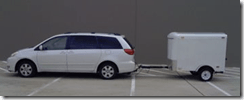 Take a tip from the US Navy: pack things up so the stuff needed first hits the venue first. I would estimate that I’ve spent about half as much on carrying bags and other containers to enable a smooth entry into the venue, as i have on a sound system, piano, stands and allsechlike.
Everything we own is labeled and stamped with a microscopic ID number, just in case. All of the cases and containers are labeled with our phone number. All of the cables and cable connections are labeled with colored electrical tape.
I started by containing cables (both lighting and power, sound and auxiliary stuff) into standard plastic filing tubs. Each book occupies its own tub as well, with two for the piano charts. All of the vocal parts are contained in another tub. (All of the book tubs are black, since they can be found up on the band stand in some circumstances.)
Stand lights go into their own tub – the required number just barely fits into one with no room to spare. The sound snake gets its own tub when we use it. All of these equipment tubs are color-coded as to their purpose, so you can look for the red tub and know at a glance that that’s where the sound cables dwell.
All of these tubs stack well in an interlocking fashion on our Rock ‘n’ Roller carts. On good ground I can wheel up to twelve tubs a trip. It takes about four or five cart trips to move the band stuff into the venue – less if we pre-pull the charts and put them all into one tub.
Speaker stands and our reduced complement of microphone stands (since going to wireless) fit into a carrying bag with rollers. (This is our heaviest item, and we have to be careful when unloading it from the trailer.) Vocal and trumpet section monitors each have their own carrying bag. Microphones and wireless mike setups go into Pelican carrying cases. Fronts go into their carrying bags. Three standard Manhasset portable stands each go into their bags., Miscellaneous items like clothespins, tools, spare pantyhose for the ladies, mark and gaffer tape, spare light bulbs, and batteries go into a medium sized duffle bag known as the “gig bag”. It is always spotted at the same place at every gig, so if someone needs a tool or something, they know where to go get it without a lengthy explanation.
If I have to haul all of the books, I can move the band’s equipment into place in four to five cart loads. (We take two carts to the gigs.) Once there, I dump it all in the middle of the dance floor, and stage my setup from there.
My wife assembles the stands out on the dance floor, readies the lights, and makes sure we have the right number of chairs. I string the light snakes, spot the chairs for the setup, and drop the stands at the appropriate point. (The books go down first on those jobs where we bring them – they then act as a setup template for my wife to spot the stands.)
She follows with the stand lights, clipping them on and hooking them up to the light snake as she goes. While this is going on, I spot the mixer and sub mixer, speakers (usually on stands) and the sound snake. We both make all the connections, using color coding on the boxes and and the “Match the color, stupid” system with the cables. (My musical director’s sons can set up our sound system, with only a final check to make sure they have got it right.
Once all this is in place, I set up the piano and run a sound check, using the demo setting on the piano. (The mixer we use automatically searches out feedback, and then handles the equalizer adjustments – sweet!) Then, I get my crap together and set up my horns, following which I hit the bathroom and get my concert dress in place.
(During all of this stuff, we both also carry a small flashlight. It helps with connections made in the dark, and we have been caught once before where the client wanted it dark so as to set their lighting while we were in the process of setting up. (They also wanted to hang a chandelier over where my lead tenor sat – that arrangement got changed really quick once I yanked out my contract and pointed out the language covering such chicanery.) I also spot a flashlight on the inside wall of the trailer, and keep one in the gig bag – you never know.
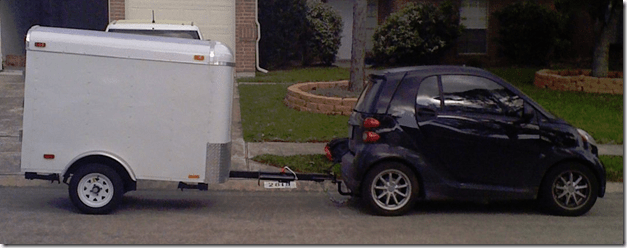
Doing it right takes about three hours, from arrival to ready for downbeat. That includes checking and double checking the sound system for the vocalists – invariably, no matter how careful you are, something gets done wrong there. We have learned to allocate five, with lunch eaten once the stuff is in the venue, and time left over to rest for the hard part, the performance.
(The lights will take a full hour, iffen we ever get them. You set them up with a rope template, made in the form of a “T”. The upright of the “T” spots on the lead alto’s stand front, and the ends of the crossbar indicate where the light stanchions are spotted off to either side of the group. String the XLRs from the stanchion and the dimmers to the computer, adjust the cross-bar angles a bit, and there’s your light setup.)
 After the final song (usually “Funny How Time Slips Away”, a great close down number), the group shuts all of the sound and electrical gear down. Once the lights are removed from the stand and stacked on the payroll table, I pay the group. Then, my wife and I pick it all up.
Going out, we generally pack stuff into the right tubs but not in a neat and orderly fashion. If we do a second job on the same day, I take the time to get it all right – otherwise it’s get it in the trailer so we can sort it out the next day.
Terry L. Stibal
Leader of Houston’s Sounds Of The South Dance Orchestra
Offering the music of yesterday, today and tomorrow…the way you want to hear it!
Visit us at www.sotsdo.com
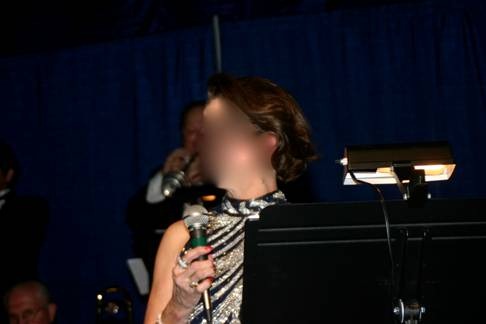 Needless to say, the portions of the video (and the two times she left her stand and that misdirected stand light in place aftershe left the stage) were a horror to view. Sound-wise and presentation-wise, she did more than okay, but visually – a real bummer.
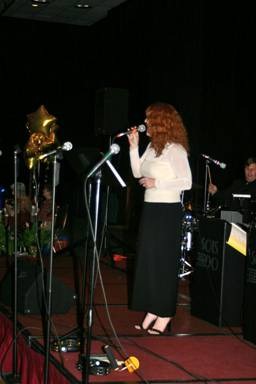 And, then there were the microphone stands. With as many as five singers out on the stand (for Twist And Shout), keeping those mikes safe and sound and in place involved microphone stands. Even if they are black, they still obstruct things quite a bit, as we see here with the lovely Anissa>
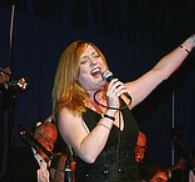
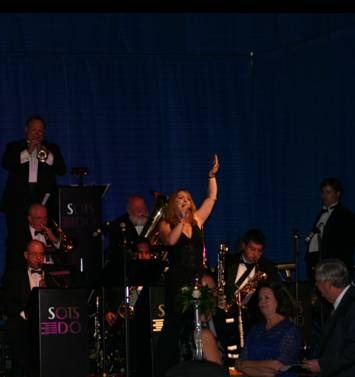 The net improvement of these two moves was striking – no more obstructions, a better view of the vocalists from all angles, and no more tangled mike cords. And, the effect was immediate. The lovely blonde lady seen above – Karron is her name – was seldom featured in any candid, performance photographs, simply because there is always a mike stand or a music stand in the line of sight. Now, open sight lines all around, as we see with the lovely Anissa here: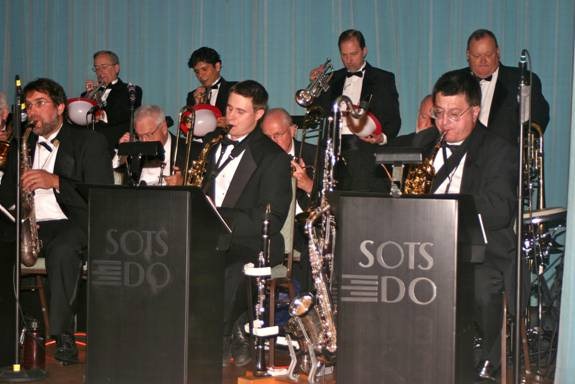














 The Bis Key Chronicles