
-
-
“I played the wrong, wrong notes.” ~ Thelonious Monk
My Fav Music Store

Quinn the Eskimo Vintage Horns
Blogroll
In the Clouds
Flickr Photos
-
Recent Posts
Blog Stats
- 446,780 hits
Subjects
Archives
Meta
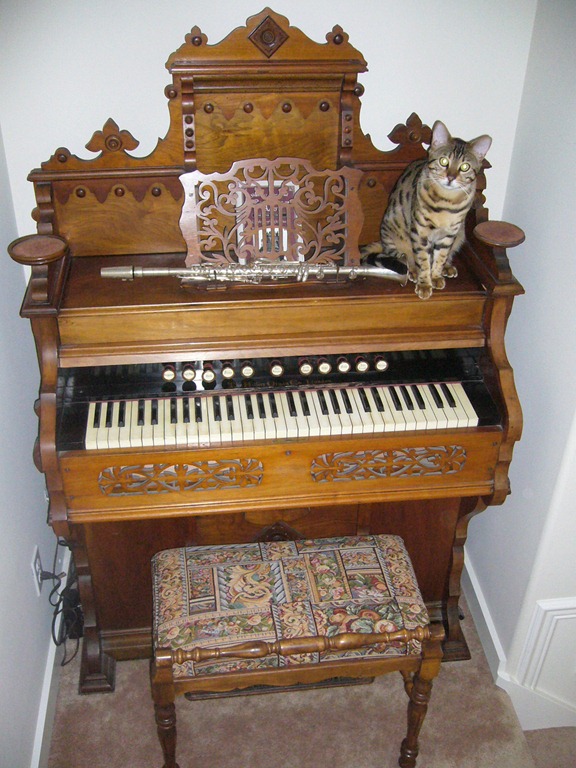 I love to purchase art that is working pieces of history. Around ten years ago I purchased a pump organ from our antique mecca, Snohomish, Washington. Shortly thereafter that I purchased Robert Gellerman’s fascinating “Reed Organ Atlas” which is a listing of an instrument that was ubiquitous in a time with no electricity. Played by pumping pedals attached to bellows, this instrument, also known as a pump organ, was a prized possession in early American homes and log cabins.
What is a Reed Organ?
Wikipedia coverage of the Reed Organ sez, “A reed organ, also called a parlor (or parlour) organ, pump organ, cabinet organ, cottage organ, is an organ that generates its sounds using free metal reeds. Smaller, cheaper and more portable than pipe organs, reed organs were widely used in smaller churches and in private homes in the 19th century, but their volume and tonal range are limited, and they were generally confined to one or two manuals, with pedal-boards being extremely rare.”
How does it work?
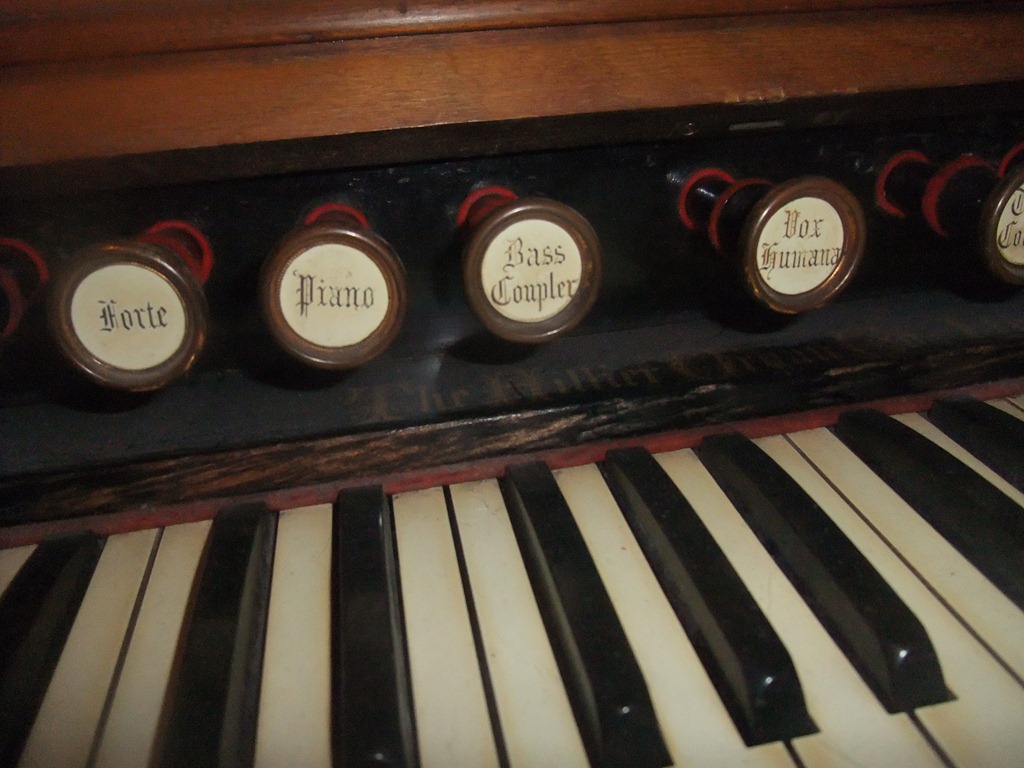 In the generation of its tones, a reed organ is similar to an accordion or concertina, but not in its installation, as an accordion is held in both hands whereas a reed organ is usually positioned on the floor in a wooden casing (which might make it mistakable for a piano at the very first glimpse).
Reed organs are operated either with pressure or with suction bellows. Pressure bellows permit a wider range to modify the volume, depending on if the pedaling of the bellows is faster or slower. In North America and the United Kingdom, a reed organ with pressure bellows is referred to as a harmonium, whereas in Europe, any reed organ is called a harmonium regardless of whether it has pressure or suction bellows. As reed organs with pressure bellows were more difficult to produce and therefore more expensive, North American and British reed organs and melodions generally use suction bellows and operate on vacuum.
Why have a Harmonium?
The bellows on my organ are mostly shot. I have hooked up an electric pump. With a pipe that comes in from the garage, the noise of the the pump is somewhat muffled. When I pump with my feet and try to play the keys, I really quickly see how hard it is. I suppose you could get used to it but it is a bit more than annoying.
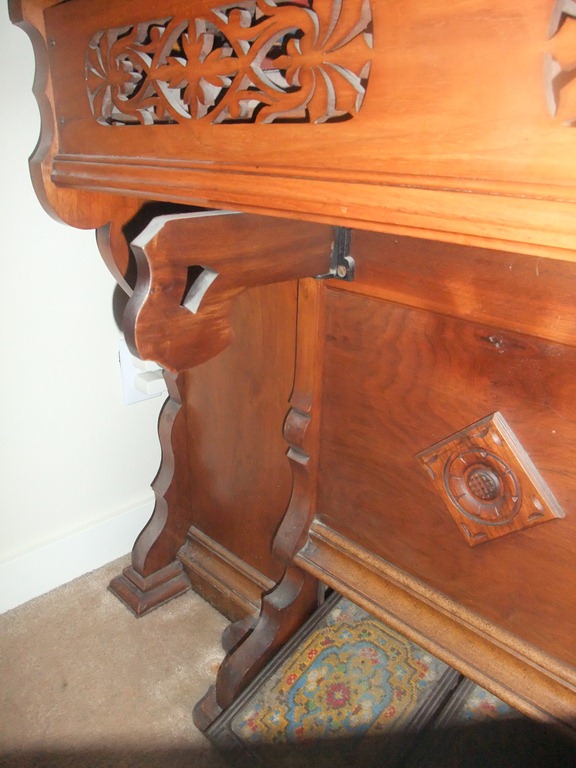

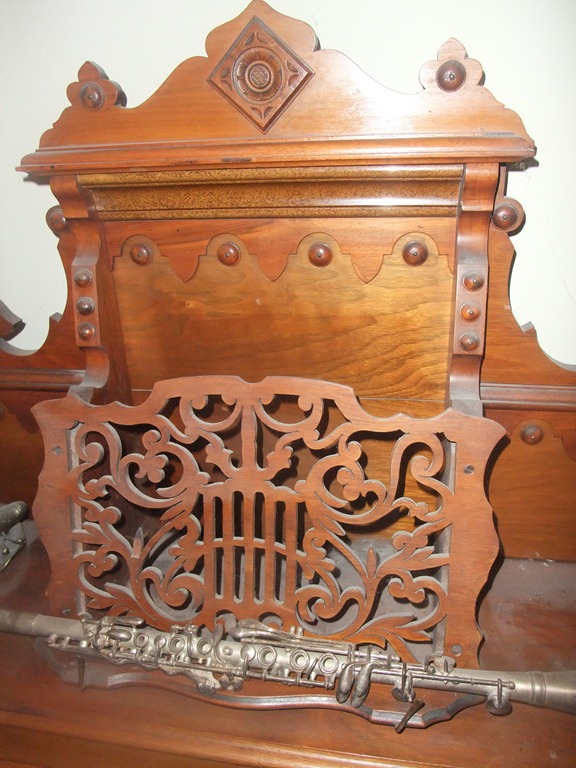
So mostly this is a piece of art in the house that generates a lot of conversation. I have less than $500 into this piece of art and the cats really like it.
At work on the company musicians alias a fellow named Wolf asks:
Why is there no B# or E#? Or to put it another way; Why are there 7 notes A-G?
There’s 12 halftones in the western octave. I get that. It’s probably something biblical, based on 12 disciples, like the 12 hour clock and 12inch foot, and the 12 houses of Astrology (sic). But what I’m struggling with is that to my mathematical mind the 12half-tones would most neatly result in 6 full tones. A-F with of course a real honest to goodness B# and E#.
Not looking for the ‘what’ which is so excruciatingly outlined in all dissertations on musical theory.
Luv these kind of questions and the musician’s alias at work provides a lot of fodder for thought. Further came home to roost as I was handed the soprano sax solo to Holst’s “Venus” to sight read. Yikes!

Hal sez: “Because what sounds melodic to the human ear in terms of a standard C major scale is designed so that the notes intoned are all whole letters – CDEFGABC (As Vincent called out. Of course the number of scale degrees obviously matters here, too). Since the intervals between the notes of the diatonic are not all uniform in equal temperament—specifically, E-F and B-C are half steps—you end up with a half-step up being just the next letter in the scale, rather than “E#” or “B#”
However, I do confess confusion about why the major scale is standardized to “C” instead of “A” –wouldn’t it make a lot more sense to call your starting note “A”?
Chad adds: “My understanding from my music theory courses was that there are mathematical relationships between the frequencies of the pitches in our standard scale. There is a definite relationship between a 1 and a 5. Then the 5 has a relationship with the note that is a fifth above it. I seem to remember that we get the standard scale using mathematical relationships until we get to semi-tones (some of which are used in Indian classical music). Not sure why they stopped at half tones but it must have sounded good to someone at some point.
Copied the following from http://www.songtrellis.com/concepts/tone: “Once musical sounds were graphed the investigators noticed that the graphs that were produced were simpler than those for other sounds. Musical sounds had wave graphs where the distance between individual wave peaks was regular. They called this distance between peaks the wavelength of the sound. By experimenting further, they discovered that two musical sounds sounded best together, when their waveforms were exactly the right length so that their wave cycles would line up and begin at exactly the same moment every few cycles for each wave. Sounds that sound unmusical together almost never fall to zero at the same time and fall to zero at the same moment at irregular intervals, if they ever do.“
Dan replies, “I think that’s a piece of the best explanation I know of for why there are 12 halftones. If you look at the values of 2^(1/12), 2^(2/12), 2^(3/12), etc., you’ll see one that is approximately 4/3 (which also happens to be the major third) and one that is approximately 3/2 (which also happens to be the fifth): probably not a coincidence that these, along with the root, make up the major chord.
As I recall, if you look at evenly-spaced fractional powers of 2, twelfths happen to yield the two values which are closest to those two fractions, until you go up to a much higher denominator (like, somewhere around 50).
But, I don’t think that helps explain why there are 7 tones in the major scale; it’s really just the third and the fifth that are very close to simple fractions, and the rest of the notes don’t really line up with anything. So, I don’t actually know of a good hypothesis to answer the original question, except effectively “because people like the sound of the major scale”.
Wolf sez: “So what I’ve learnt is that I was really asking two questions;
1. Why are the standard western scales diatonic? B-C and E-F being tonics, two being ‘dia’. The answer appears to be ‘coz it just sounds the best’
2. Why is the standard music notation heptatonic scale based and not normalized to either the Chromatic or the whole tone scale ?
For example on the diatonic notation the scale of e is e f# g# a b c# d# [e]
Whereas if that was written on a whole tone notation that would be E F A A# B# C# D# [E]. However A + A# doesn’t fit even using flats E F A Bƅ Cƅ Dƅ Eƅ [E] as that results in a double E.
So I guess the answer to the second part is that the diatonic scale simply can’t be translated to a whole-tone notation without an ambiguous note.

The other option would be to use a chromatic notation with notes labeled A-L. Of course any western scale can be played on the 12 half-tones regardless of how they’re labeled.
The wave-theory/harmonics is an interesting avenue to follow. I’ll also look into that more. Especially in chord formation and keys.
Read more at: http://en.wikipedia.org/wiki/Wolf_fifth where you will find great charts like this one (below).

Are we having fun yet? :O)
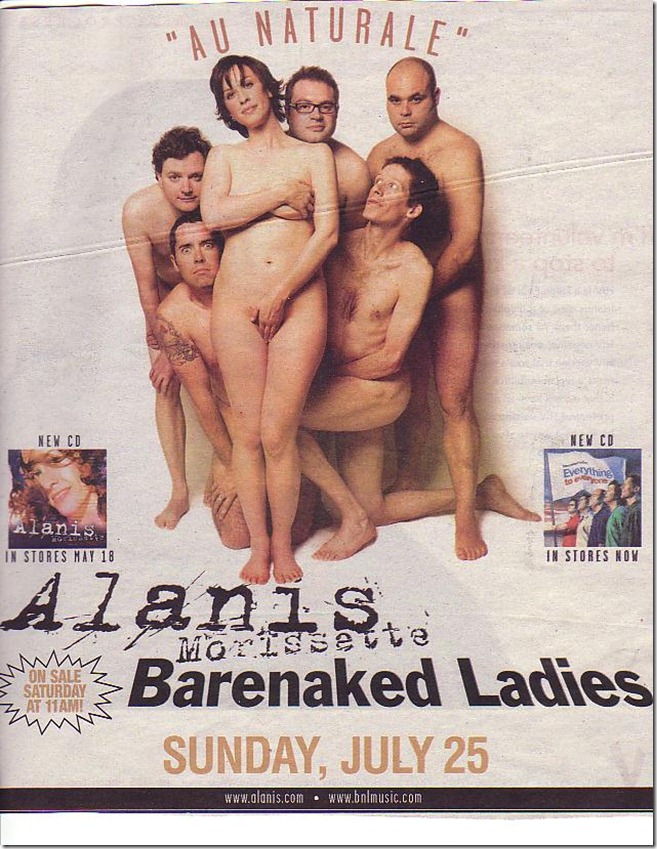
I am going to throw in some pictures that I like because they are cool, make me laugh, and make me wonder, “What were they thinking?” I am guessing that Alanis did NOT recommend this shoot.
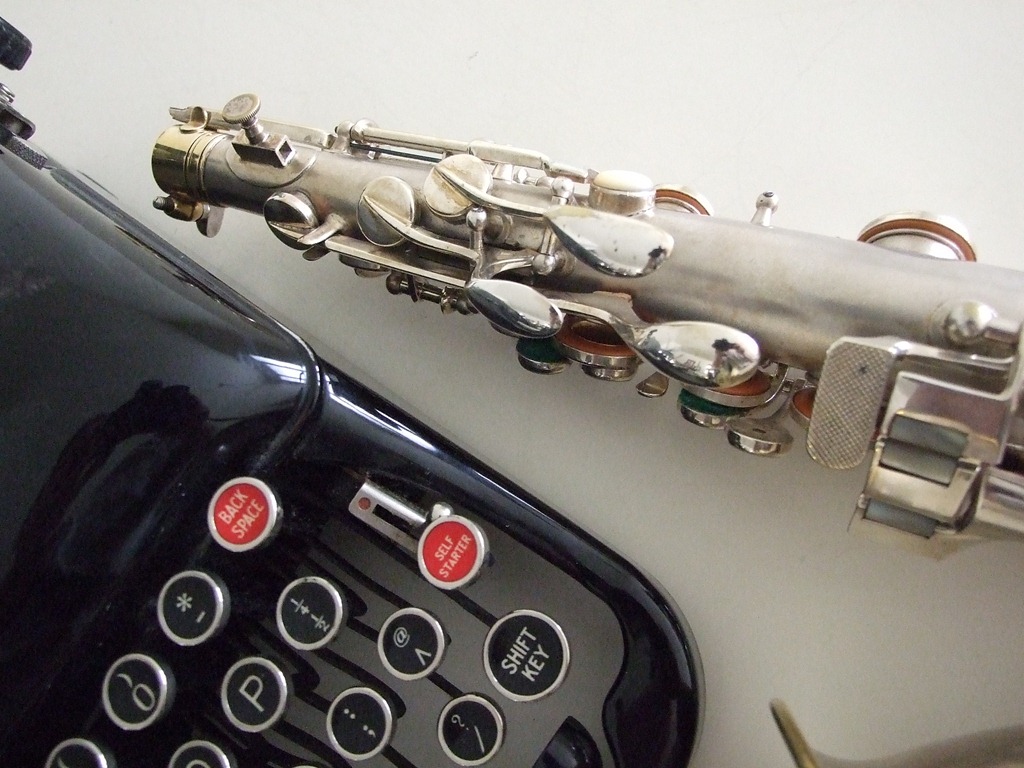 As I explore the world of WordPress I keep seeing pictures of old typewriters, just a shot of some of the keys, or even antique typesetting pieces. I purchased an old typewriter last year off eBay to use as a prop. The typewriter I used in the 70s and 80s long gone, I looked for a typewriter that was more artistic that useful. I did not miss the old days of correcting errors with whiteout, strip tape or gawd forbid, an eraser.
Why are many of us attracted to antiques? I am as guilty as anyone in my unabashed luv of artifacts from the last two centuries. Heck, I have a pump organ, also known as a harmonium, in my entryway. You know across from the early 20th century tube radio. And in the garage you will find a ‘57 Schwinn Wasp in pristine condition. Mostly I just look at these things, well when I’m moving slow enough to notice them.
So I’m wondering, is the typewriter still an icon for the world of writing? Or is it just wistful art, a curiosity from days long past? How many of our kids can identify a typewriter as a writing utensil?
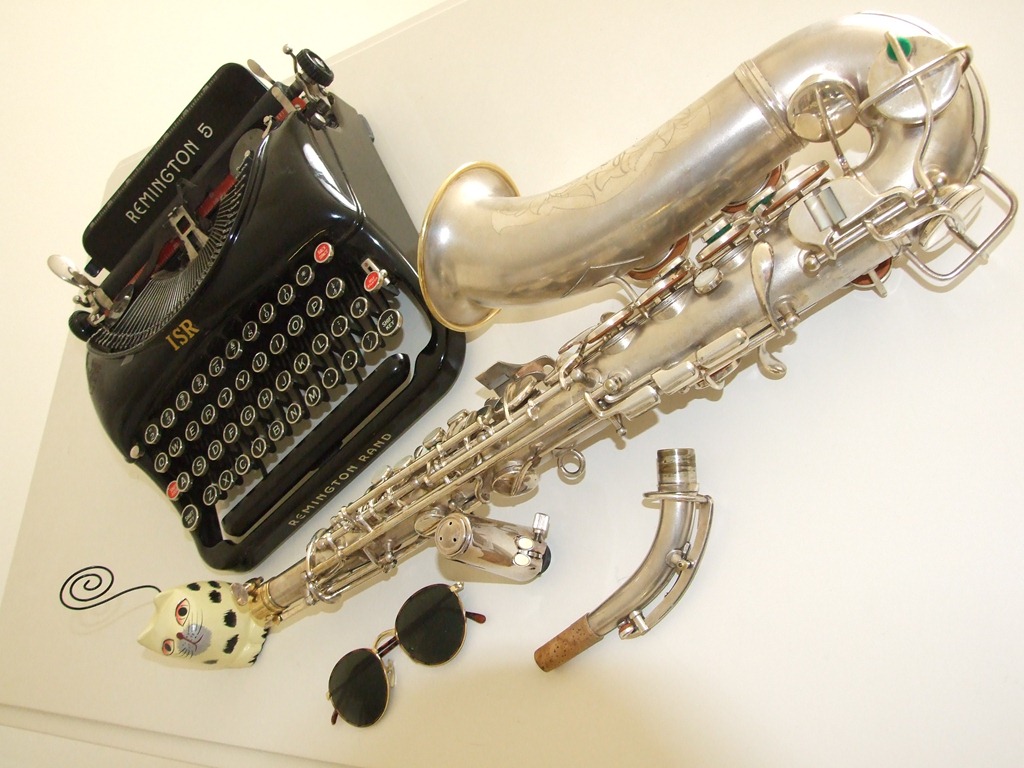
Just to tie this up for a blog that is mostly about music, the sax pictured here is a fully functional, albeit rare, Conn F Mezzo soprano saxophone. It is sized between the soprano and alto in the saxophone family. This was a picture that I took for the Woodwind Forum calendar. It made the cover. :O)
It is amazing how you can portray a movie however you want in a trailer. For example, this recast makes the humorous movie Ghostbusters seem like an epic. By using the the Inception music “Mind Heist” the tone, take, recast is a departure from the original and fascinating. Music is a powerful thing.
I saw these two posts again on Facebook and thought I’d share them here. The imagined and real battle for supremacy between the cat and the dog is fodder for many humorous and/or horrific stories.

Excerpts from a Dawg’s Daily Diary:
8:00 am – Dog food! My favorite thing!
9:30 am – Boy oh boy, a car ride! My favorite thing!
9:40 am – A walk in the park! My favorite thing!
10:30 am – Got rubbed and petted! My favorite thing!
12:00 pm – Lunch! My favorite thing!
3:00 pm – Wagged my tail! My favorite thing!
5:00 pm – Milk Bones! My favorite thing!
7:00 pm – Got to play ball! My favorite thing!
8:00 pm – Wow! Watched TV with the people! My favorite thing!
11:00 pm – Sleeping on the bed! My favorite thing!
Gawd, I so love my parents!
Excerpts from a Cat’s Daily Diary:
Day 983 of my captivity…
My captors continue to taunt me with bizarre little dangling objects. They dine lavishly on fresh meat, while the other inmates and I are fed hash or some sort of dry nuggets.
Although I make my contempt for the rations perfectly clear, I nevertheless must eat something in order to keep up my strength.
The only thing that keeps me going is my dream of escape. In an attempt to disgust them, I once again vomit on the carpet.
Today I decapitated a mouse and dropped its headless body at their feet. I had hoped this would strike fear into their hearts, since it clearly demonstrates what I am capable of. However, they merely made condescending comments about what a ‘good little hunter’ I am. Bastards!
There was some sort of assembly of their minions tonight. I was placed in solitary confinement for the duration of the event. However, I could hear the noises and smell the food. I overheard that my confinement was due to the power of ‘allergies.’ I must learn what this means and how to use it to my advantage.
Today I was almost successful in an attempt to assassinate one of my tormentors by weaving around his feet as he was walking. I must try this again tomorrow — but at the top of the stairs.
I am convinced that the other prisoners here are flunkies and snitches. The dog receives special privileges. He is regularly released – and seems to be more than willing to return. He is obviously retarded.
The bird has got to be an informant. I observe him communicating with the guards regularly. I am certain that he reports my every move. My captors have arranged protective custody for him in an elevated cell, so he is safe. At least, for the time being.
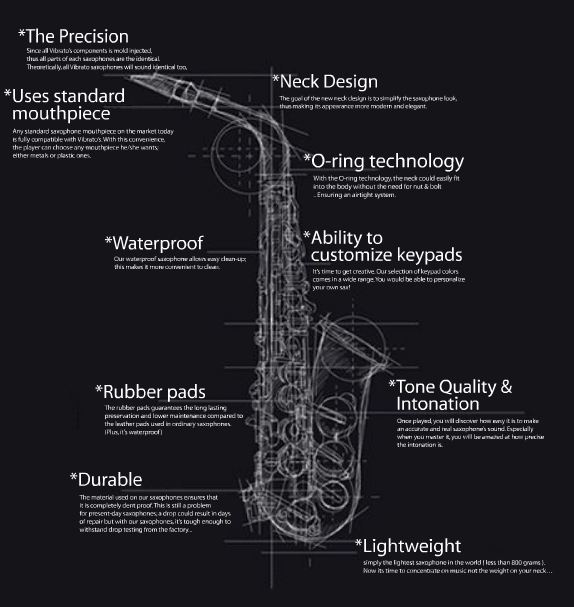
Meet the amazing plastic sax, the VibratoSax introduced and made available in 2010. The first models are around $400 plus shipping at last check.
 You might remember that Charlie Parker played the first ever (and last I think) plastic alto sax that made it to production, the Grafton sax. Those instruments are extremely rare and even rarer in playable condition. I think the last one sold for ~$15,000 on eBay. Charlie’s sold for even more.
The saxophone forums like the Woodwind Forum has been talking about this new instrument and manufacturer for a while now. Here are the threads I’m following now:
And here’s the video which is astonishing because the performance is better than those I’ve heard from the manufacturer:
I think the video of this instrument (above) speaks with more authority than many of the guesses, speculation, and out right disses by those who have not seen the instrument. Although I don’t think this instrument will replace my primary sax anytime soon, it is a fascinating event in the history of the saxophone. I have placed a request on many of their videos for a Charlie Parker tribute VibratoSax to be made with the same cream color, unique key shields and gold lacquer neck, keys and touches as the original. We’ll see.
 From my friend JBT, “I read this great link which had some very worthwhile and practical information for beginners on an instrument: http://www.bretpimentel.com/seven-ha…ive-beginners/.
However this was obviously written by a university professor and was based on habits observed in his most successful university students. This got me thinking that there might be a need for more down to earth list, say for beginning band students in elementary band programs. Having taught beginning bands for 27 years here are some of the habits I observed in my more successful saxophone students.
1. Blow in the small end. It is important for two reasons, first you look much more “professional” to the teacher and other students and two it is far easier to get your lips around the small end.
2. Put the mouthpiece on with the reed facing down. A more satisfactory sound can be achieved when your top teeth are not on the reed, and if you hold the saxophone so that the lower lip contacts the reed, your arms will tend to get tired very quickly holding the saxophone above your head.
3. Have the left hand on top and the right hand on the bottom. It is quite possible to play some of the notes this way, but like batting “cross handed” it doesn’t work as well and you could injure yourself playing fast runs.
4. Swallow what’s in your mouth BEFORE you blow. This is critically important. You paid good money for that candy bar or those chips. You don’t want them wasted stuck down inside your instrument.
5. When there is a substitute teacher day, always play a different instrument. The substitute will never know the difference, thinking the class always sounds like that, and you get a chance to try a lot of different instruments. Who knows, you might want to be a band teacher someday.
6. Be sure to tell your mom at 6 pm the night of the concert which starts at 7:30 that you need dark slacks and a white shirt. If you wait till after 6 to tell her it would be inconsiderate, and might result in you being the only one not dressed the same.
7. When you squeak in the rehearsal, turn and give your stand partner a dirty look. The director will think he did it, and your stand partner won’t know for sure.
8. When you break your only reed right before the concert, be sure to tell your director as you go onstage. He will appreciate you caring enough to let him know.
9. Play very softly in all of the practices and then really loud in the performance. Your mom and dad paid a lot of money to rent or buy that saxophone, you owe it to them to hear you in the concert over everyone else in the band.
10. Always stop playing immediately when the conductor stops waving his arms. This is true even if you are only part way through the song. It gives the director the false impression that he is in control of the music. This rule doesn’t apply the night of the concert when you are far too nervous to look up.
Happy New Year ~ JBT who sez, “I’m glad you liked it. A sense of humor is a must when you teach beginners as long as I did.”
Quinn the Eskimo Vintage Horns


 The Bis Key Chronicles